NM3D Ibérica participated in the HAARO seminar –
Context and challenge
Metrology facing a new industrial challenge
Industry has evolved rapidly in areas such as automation, robotics, digitalization and data integration. However, in many companies, metrology continues to function as a separate stage from the production process.
Frequently, a part leaves the production line, is transported to a measurement room, manually prepared, positioned on equipment, measured, analyzed and only then does the information return to the industrial process.
This flow can be technically rigorous, but is not always agile enough to respond to current industry demands.
The challenge is no longer just to measure with greater precision. It is to better integrate measurement into the production flow, reducing unproductive times, increasing traceability and allowing quality data to reach decision systems earlier.
The solution or technology
VIRIATO: a physical interface between part, equipment and data
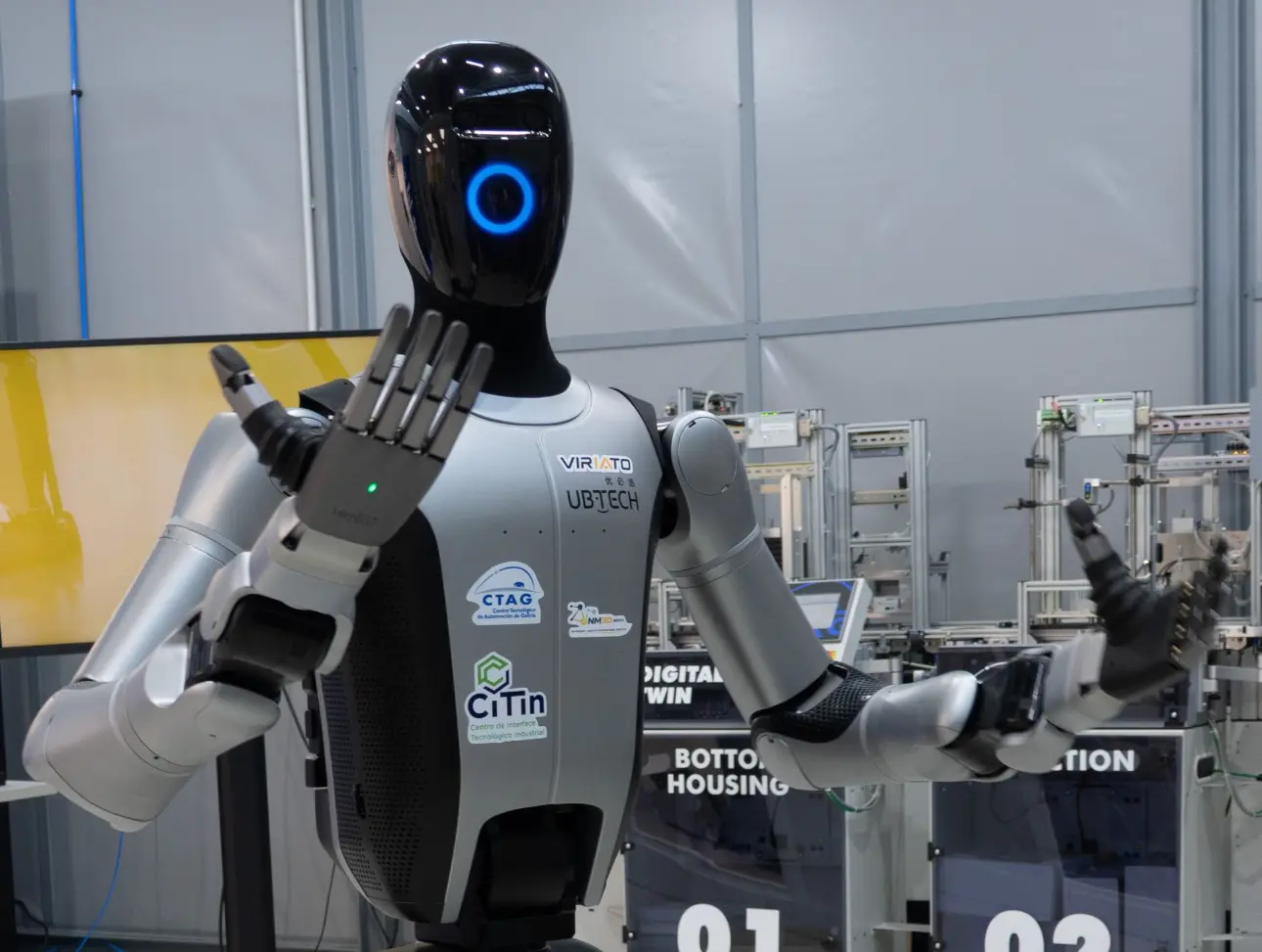
During the presentation, NM3D Ibérica introduced VIRIATO as a practical representation of a new interface between the physical part, metrology equipment, digital systems and industrial decision processes.
Humanoid robotics presents a relevant advantage for industrial and laboratory contexts: many of these spaces were designed for people. Walkways, benches, doors, controls, tools, workstations and laboratory equipment follow human dimensions and interaction logic.
Unlike a fixed robotic cell, a humanoid can, in certain applications, operate in existing environments, move between different zones, interact with equipment and support manipulation, preparation and positioning tasks.
In NM3D Ibérica's vision, the humanoid does not replace metrology nor does it replace the specialist. Its role is complementary: supporting repetitive tasks, facilitating physical integration of processes and allowing technicians to focus on higher value-added activities, such as analysis, validation and continuous improvement.
MAHIA: a technological vision for autonomous metrology
The presentation also developed the technological vision associated with the MAHIA concept – Autonomous Metrology using Humanoids and Aerial Integration.
The focus presented by NM3D Ibérica was exclusively technical and industrial: how to integrate logistics, manipulation, measurement and data in a more continuous flow.
In this model, measurement does not begin only when the part arrives at the laboratory. It begins when the system identifies an inspection need. From there, the flow can include part identification, collection, transport, preparation, manipulation, positioning, measurement, dimensional analysis and return of information to production.
The objective is to reduce fragmentation between production, logistics, metrology and data, creating a more integrated, traceable process aligned with industrial reality.
Integration with industrial metrology technologies
NM3D Ibérica works with an ecosystem of technologies oriented toward dimensional inspection and industrial quality control, including coordinate measuring machines (CMM), industrial computed tomography (CT), 3D scanners, optical metrology, dimensional inspection systems and analysis software.
Humanoid robotics can add a physical integration layer to this ecosystem. Instead of viewing metrology only as an isolated laboratory operation, the proposal is to think of measurement as part of a continuous industrial flow.
This approach allows imagining processes in which measurement equipment, humanoid robots, inspection software and industrial systems work in a coordinated and integrated manner.
Industrial applications
A progressive path toward metrological autonomy
NM3D Ibérica advocates that adoption of this type of technology should be done progressively.
The first step is to identify a concrete use case: a part, a process, equipment and a clear improvement point. Then, it is necessary to define the physical and digital flow, map the environment, integrate the humanoid, connect the data and validate the system under real operating conditions.
Only after this validation does it make sense to move toward scaling.
Results and benefits
Potential benefits for industry
Among the potential benefits are reduction of unproductive times associated with waiting, transport and preparation, greater availability of high-value metrology equipment, improved traceability, greater integration between quality and production systems and greater flexibility for short series and variable references.
The proposal is not based on absolute promises, but on a progressive and industrially realistic vision: identify concrete use cases, validate the flow, integrate the humanoid, connect the data and scale only when value is clearly demonstrated.
How NM3D can help
For NM3D Ibérica, the future of metrology is not just about measuring better. It is about better integrating measurement into production reality.
Quality should not arrive late. Measurement should not live in isolation. And dimensional information must become an active tool to improve industrial processes.
The future of metrology is autonomous, connected and at the heart of production.
Would you like to assess this solution for your application?
To learn more about NM3D Ibérica's solutions in industrial metrology, 3D inspection, industrial tomography and technological integration, contact our team.